


By Katie Azevedo, M.Ed.
The first few weeks of your new semester are usually okay. You have your fresh notebooks. You’re rocking a new planner. And you’re bursting with motivation and the intention to have the best semester ever.
But then you realize you have three tests next week. Your math class is covering a unit that feels like a foreign language. And you’re starting to freak out about the huge essay due next Tuesday.
On top of that, your after-school activities are picking up. You have like 10 emails you haven’t replied to. And the application deadline for that thing you want to do is …tomorrow.
So now, your fresh notebooks are full of notes that don’t make sense. Your planner is empty because you’re too overwhelmed to write anything down. And the motivation and intention you started the semester with are replaced by panic and procrastination.
I see this situation all the time with students I work with. (In case you didn’t know, I’ve worked with thousands of students over the past 20+ years.) Students will start the semester off strong, but then everything explodes the minute school gets a little hard or their schedules get a little chaotic.
While this is a common scenario, it can have devastating effects on your grades, GPA, and entire school experience. But the good news is that I know exactly what’s going on and how to fix it.
Why New Semesters Make You Feel Good (And Trick You Into Thinking Everything’s Under Control)
There’s something magical about starting a new semester with fresh notebooks, a new homework planner, and the intention to “lock in this time for real.”
But having a few new tools and a temporary burst of motivation isn’t a sustainable way to get the academic success you’re looking for.
Sure, your pretty notebooks, cool new pens, and your new-semester excitement might last a few weeks before things get really hard. But the true test of good school habits is whether your tools and systems can carry you through the hard and busy times too.
When everything feels manageable, like at the beginning of a semester, of course it’s easy to take notes – because your teacher is going slowly and covering introductory material.
Of course it’s easy to study for your first test – because it’s basically just a review of things you already know.
Of course you don’t feel too overwhelmed with your schedule yet – because your activities haven’t picked up and you don’t have overlapping commitments yet.
But students who do well in school without losing their minds have school habits and systems designed to withstand the pressure of multiple deadlines, multiple tests, and weeks that feel like you have seven bazillion things going on.
That’s the test of a good academic system. Can it keep you afloat, keep you calm, and keep you focused during your hard weeks, and not just on a boring Tuesday when you’ve got nothing going on?
Why Everything Falls Apart When School Gets Hard
The reason your school habits (and everything else, basically) fall apart when things get hard is that you have individual tools and individual systems that don’t work together.
You might have a planner, but that’s not a full task management system that works together with your time management system.
You might have a calendar, but that’s not a time management system that syncs with your task management system.
You might have nice notebooks, but that doesn’t mean you take good notes or have a knowledge management system that integrates with your study system.
You might know a few random study methods, but isolated study methods don’t work if you don’t have a time management system and a knowledge management system.
You might have 10 cool folders, but that doesn’t mean you have an analog and digital organization system that integrates with your study system.
Individual tools, systems, and strategies do not carry you through hard times. They do not help you during busy weeks or hard classes.
The answer to academic success and peace is not buried in how you feel and what you can achieve when things are really easy. It’s in how you feel and what you can achieve when things get hard – which they will, because it’s school.
How to Create a School Habits System that Doesn’t Fall Apart When School Gets Hard
We’ve just covered that having individual strategies and tools is a fast way to crash out during hard weeks or when your classes get more difficult.
The solution, therefore, is to do the exact opposite of what you’ve been doing.
The secret to keeping your new semester motivation, peace, and control going all school year is just a two-step process:
- Build your Core Six Student Pillars.
- Connect your Core Six Student Pillars so they work together as one academic operating system.
Below is a graphic that illustrates the interconnection between each of the Core Six Student Pillars.
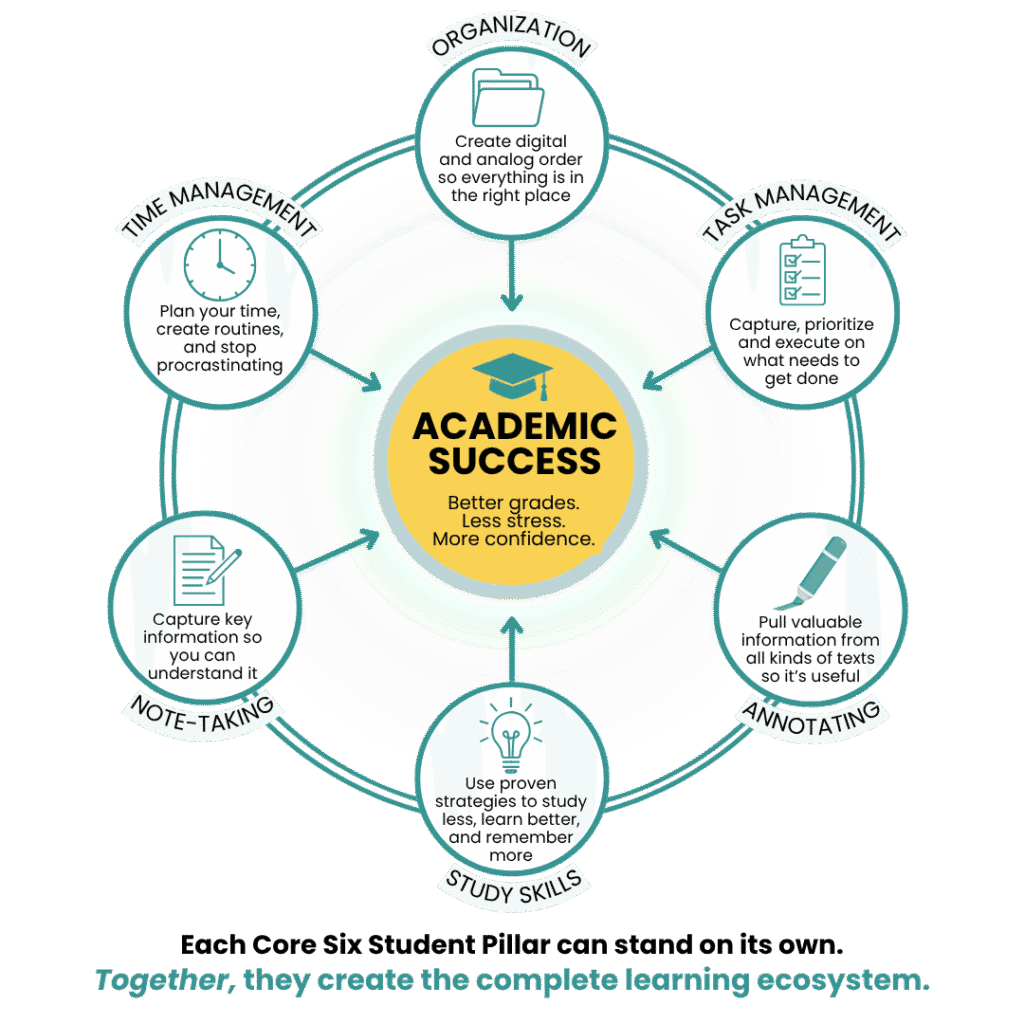
This isn’t as complicated as you think. Let’s break down each step.
1. Build Your Core Six Student Pillars
This is the name I’ve given to the six most critical systems that students need to succeed in school without losing their minds. These six systems can get any student through the most challenging courses and programs.
The Core Six Student Pillars make it possible to get better grades without studying any more or working any harder than you are now.
After over twenty years of teaching, I’ve identified the Core Six Student Pillars as the following:
- Task management
- Time management
- Note-taking (knowledge management)
- Annotating (knowledge management)
- Study Skills
- Organization
Each of these six core student pillars must be created and refined before you can get to step two. In other words, you need the following:
- A task management system that lets you accurately and simply capture and execute on everything you need to do and when to do it. I teach you exactly how to do that in my Assignment Management Power System.
- A time management system that makes time visible, giving you a clear and accurate picture of deadlines, due dates, tests, and other commitments.
- A knowledge management system that involves note-taking and annotating strategies that turn your lectures and course materials into easy-to-understand and easy-to-study resources. I teach you exactly how to do this in my Note-Taking Power System.
- Study skills and strategies (based on REAL cognitive science) that let you study less and remember more for your tests.
- An organization system for your analog and digital assets, including email, so your files and materials are useful, and not overwhelming
Once each of these Core Six Student Pillars is created, the next step is to connect them.
2. Connect your Core Six Student Pillars so they work together as one academic operating system.
Each of the above systems is useful by itself, but the real power comes when you link them together in a larger academic operating system.
Let’s take task management, for example.
You know it’s critical to know what your tasks are, whether they’re assignments, long-term projects, or to-dos related to your after-school activities and part-time job.
Without question, you need a task management system that tracks these things from the moment they are assigned to the moment you complete them.
But your task management system becomes an academic weapon when it integrates with your time management system.
When these systems are synced, you know exactly:
- when you’re going to complete your tasks without procrastination
- which days of the week you have time to schedule your spaced repetition study sessions
- when you need to start your long-term projects so you’re not completing it the night before they’re due
Your task management system also becomes more powerful when it’s connected to your knowledge management system, which includes your notes.
For example, let’s say that one of your tasks is to start your research paper. That task is going to become a million times easier when you have good notes that contain the exact information you need to write your paper.
Your task management system also becomes more powerful when it’s connected to your study system. For example, if one of your tasks is to study for next Friday’s test, it’s super helpful to know the FOMSO study method. (This is my proprietary study framework that helps you figure out exactly what you’re studying, when, and what methods to use so that you’re not just memorizing information you’ll forget before the test. I teach this inside SchoolHabits University.)
Finally, your task management system works so much better when it integrates with your organization system.
For example, if one of your tasks is to prepare for your computer science presentation, your job becomes a lot easier when you know:
- where your notes are
- where the digital resources are that your teacher shared
- how to find the email your teacher sent with updates about assignment requirements
This is just one example using task management. I could do the same exercise using each of the Core Six Student Pillars, showing you how each one relates to and depends on the others.
What Happens If You Keep Winging It Without an Academic Operating System
I can’t emphasize this enough: Without each pillar built on its own and then connected to the other five, your school habits will fall apart, and your grades will suffer when school gets hard.
You’ll feel good for the first few weeks of a semester. But then you’ll quickly become overwhelmed again when you have multiple due dates and deadlines happening at once.
You’ll resort to your familiar study methods that feel like studying but don’t actually do anything to get the information into your brain.
You’ll fall back to telling yourself you’ll remember what was said in class because you’re too overwhelmed to take notes and you aren’t quite sure what to write down anyway.
Your Next Step (How to Make All This Magic Happen for Real)
The secret to good grades without studying any more or working any harder is exactly what I’ve outlined in this blog post. However, I also know it’s not easy to create these systems and learn how to integrate them on your own.
That’s exactly what SchoolHabits University is for. SchoolHabits University is my most popular study skills program that teaches the Core Six Student Pillars and how to link them in the ultimate academic operating system.
In the program, I help you set up each of the systems, tweak them to fit your brain, especially if you have ADHD. I also offer live coaching on Zoom for a full year to ensure everything works perfectly for you.
Knowing what the Core Six Student Pillars are is only the first step. Creating them is the second, and that’s exactly what we do inside SchoolHabits University.
If you’re ready to do things differently and get the grades you deserve, without all the extra work, join me inside SchoolHabits University.